A Funny Story About Sheep…

Yesterday for our sermon we talked about how sheep are quite helpless creatures. They tend to follow a leader and don’t always act out of intelligence. One of the deeper points of Jesus’ parable of the lost sheep is that we usually go astray and feel helpless. The good news is that God is always looking to find us.

One of the most memorable stories I’ve ever heard about sheep has to do with one from New Zealand back in 2004. (I didn’t use this as an example yesterday as a sermon illustration because words don’t do this story justice–you need to see pictures!).

Meet Shrek the sheep. Perhaps you heard this news story when it broke many years ago. Shrek gained international fame when he was discovered in rural New Zealand. They didn’t actually think he was a sheep at first, considering how ridiculously thick his wool was! Shrek had run away from his shepherds for about 6 years by hiding in caves. After catching this rebellious sheep, the farm owners shaved off 60 pounds of wool… enough to make nearly a couple dozen suits!

The bible often uses metaphors and symbolism to explore our relationship with God. In the case of the parable of the lost sheep and Psalm 23, God teaches us that we are exactly like sheep. Without God’s help, we aren’t that smart. We are actually in danger if we fail to pursue God.

Shrek the sheep’s story provides a bit of comical insight into our faith…

  • We aren’t just helpless creatures as humans… we are often rebellious! We tend to run away from the guidance of our good shepherd.
  • It is often the case that when God feels distant from us, it is we who are hiding instead of God.
  • Without God’s help and protection, our life becomes an absolute mess. Sure, we might think we can survive without God, but we end up in a dark place without that divine relationship.

Growing One by One

As the parable of the mustard seed teaches us, God’s work often develops over time. Let’s zoom out for a minute and reflect on the growth of Christianity throughout human history… Because in many ways, God’s ever-growing family shows what mustard seed faith looks like in practice!

Roughly 2,000 years ago, Jesus started off with only a handful of followers. There were twelve named male disciples, several other women who also followed him, and a few others who experienced Jesus’ miracles firsthand and decided to stick around. All in all, Jesus only had a small group with which to start.

Yet in the years that followed, Christianity absolutely exploded. Churches grew and apostles planted new ones. Even in the midst of systematic persecution by the Roman Empire, Christianity grew like wildfire. We’ve seen this rapid rate of growth in recent times, too, with the Chinese church. For many years, outside missionaries were prohibited from traveling to China. It was a common assumption among outsiders that the church in China had shrunk and most likely disappeared. Yet a couple of decades ago, when authorities eased travel restrictions, outside missionaries soon discovered a hidden, but growing church throughout the country. Christians in China were not counted in thousands (as many had assumed)… instead they were counted in the tens of millions. (Last I checked, some estimates are that there are 54+ million Christians there!).

So how could the church go from a tiny group in Jesus’ day to a big, massive, and expanding one? How could Jesus and his followers have created a movement that spans continents and generations? How could the persecuted underground Chinese church grow into millions upon millions?

The main reason for growth has to do with how Jesus did ministry. After rising on Easter and before ascending to heaven, Jesus commanded his followers to make disciples of all nations (Matthew 28:19-20). And disciples don’t just stay disciples by themselves. True disciples share God’s word and make other disciples. To use the mustard seed illustration, we continue to plant and watch God work in the lives of other people. Those whose lives are changed repeat the process with others, too.

To illustrate how this works, it is worth considering a math example. Discipleship and evangelism should never be efforts of addition, but rather an exponential process. When you add numbers together, the end result is obviously bigger than before (2+2+2+2=8). But when we multiply a number, and repeat that process, the outcome is even greater (for instance, 2 to the power of 4, or 2x2x2x2=16).

For instance, if the friend you evangelize comes to church, and then he or she does the same thing, too, both of you reach more people. If you minister to someone and they in turn minister to other people, we see Christianity grow exponentially, because the process continues on.

As Paul, Timothy, Ephaphras, and others continued to evangelize, they reached countless men and women for Christ. It might seem like you’re only just reaching one person, but what if that individual goes on to impact even more people? That’s how movements work.

It is worth reflecting on these questions this week…

  • Are you reaching people for Jesus?
  • Do the people you show love to develop a desire to share that love with others?
  • Are you being a disciple who makes other disciples?
  • Are you “dreaming big” of growing God’s family?

I find myself asking these questions of myself often in ministry at Concord. It is so important for us to remember to share God with others. It might seem like a slow process and like we are just reaching one person… but hopefully that one person experiences the joy we have, and shares it with the next person in need!

Pastor’s Bookshelf: Hannah’s Child, The Powers That Be

In addition to weekly posts about the sermon, I’m going to start providing brief updates and summaries of books I’ve read! This’ll probably happen every month or so. Part of this blogging practice is for me to keep myself accountable… I’ve been meaning to read intentionally more over the past few months! I feel this helps me better serve Concord as a pastor as I preach and do ministry. So in writing new posts about reading, you can also take a peek into what has shaped me in my studies.

Anyways, here is a brief recap of two interesting books I recently finished…


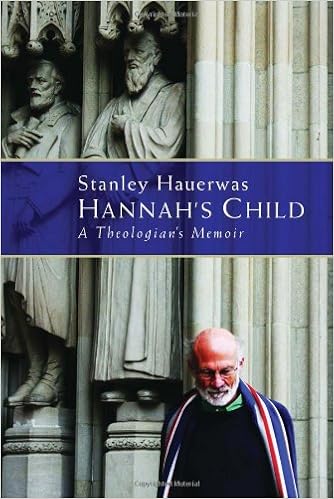
Hannah’s Child by Stanley Hauerwas

I often reference Stanley Hauerwas in my preaching. He’s a professor at Duke Seminary and one of my favorite authors. In Hannah’s Child, Hauerwas writes a memoir of his life as a child in working class rural Texas, a promising university student, and eventually a career academic theologian. Hauerwas was raised most of his life in the United Methodist Church and talks about how this impacted his life’s trajectory.

The title Hannah’s Child is loosely based off the story of Hannah and her child Samuel in 1 Samuel. As in scripture, Hauerwas’ mother promised to dedicate her child to God’s service. This has deep connections with a central question he wrestled with most of his life: how do you be a Christian in our world? Hauerwas also details his life’s struggles in a brutally honest way, perhaps most notably his marriage to someone with a severe mental illness. He was also named Time’s “Best Theologian” in the early 2000s, and had to navigate a more public life as an “expert” on Christianity. Hauerwas’ argument is that the church must always be a holy witness in our world. That doesn’t always come easy, and requires us to be committed for God’s service.


Cover Image

The Powers That Be by Walter Wink

I always dig into Wink’s articles and video lectures anytime I preach or teach about violence and peace in the bible… so I figured I would read this book since I hadn’t before! The Powers That Be offers readers a paradigm shift for how Christians are called to take Jesus’ words seriously about being peaceful and forgiving. In our world, it is so common to response in-kind to things like hatred, anger, and physical violence. When someone hits or insults us, we almost always hit or insult them back.

Wink offers many compelling theological and biblical arguments for why nonviolence is the way to go in following Jesus. Perhaps most notably, Jesus commands us to “turn the other cheek” in the Gospel of Matthew. As Wink dives into the ancient Greek language and meanings of words, he talks about what this would sound like to Jesus’ audience back then. Jesus uses the word antistenei, which has its linguistic roots in military battle. Stenei was a verb to describe when two armies would systematically march towards other and engage in a horrendous bloodbath. To add the prefix anti- to this root word means that Jesus commands us not to respond as our oppressors or enemies do. In other words, Jesus is saying, “Stop marching towards one another like a bloodthirsty army!” We should stop drawing our swords and instead be more creative in addressing worldly evil. Jesus famously offered the cheek response, as well as offering up our cloak and going the second mile.

I found The Powers That Be to be a very convicting book. Hitting and fighting back are so common in our culture. We think we can kill or hurt our way into a better world. In reality, the gospel teaches us that the only way to truly be saved is to be like Jesus. We often think that bombs, guns, and physical force will give us true security, but salvation is found in Christ alone. His redemption is truly the only way our world can ever change.