Being Thrown Into Hell

In Matthew 5:27-30, Jesus gave his timeless teaching on how sin works in our life, using the example of adultery and lust. To refresh your memory from yesterday’s sermon, here are Jesus’ words once more:

27 “You have heard that it was said, ‘You shall not commit adultery.’ 28 But I tell you that anyone who looks at a woman lustfully has already committed adultery with her in his heart. 29 If your right eye causes you to stumble, gouge it out and throw it away. It is better for you to lose one part of your body than for your whole body to be thrown into hell. 30 And if your right hand causes you to stumble, cut it off and throw it away. It is better for you to lose one part of your body than for your whole body to go into hell.

Even though Jesus’ uses an example of hyperbole or exaggeration, these words still apply in a deeply practical way. Don’t let anything cause you to sin… It is better for you to throw it away than to suffer a terrible fate!

But what does Jesus exactly mean when he says we should avoid sin lest “your whole body to go into hell?”
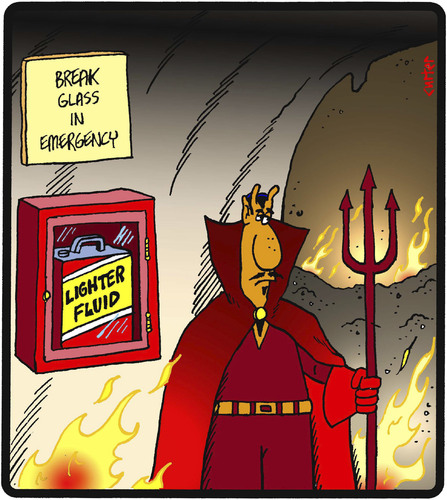
Image result for hell cartoon

If you ask me, I believe that Christians have a somewhat rocky history with the idea of hell. Our beliefs about it mainly come from non-biblical sources like Dante’s Inferno, horror movies, or even cartoons. For instance, we usually imagine Satan to be a guy in a red leotard with pointy horns!

And in the religious world, some pastors might use the idea of hell to scare people into heaven. Other Christians might even threaten others with eternal damnation, treating God like a vindictive, unloving being. People often warp the very purpose of Christianity to mean a “get out of jail free” card. Christian tragically becomes an exercise of avoid hell, rather than a call to love Jesus Christ for his sake.

But when Jesus talked about hell in this passage, he had a radically different way of describing it that a scary movie. The specific word he used was Gehenna. Jesus used this word as a reference of an actual physical place near the city of Jerusalem during ancient times:

Modern day picture of the region Jesus referenced

If you happen to have a set of maps included in your bible, Gehenna might actually be included in a map of ancient Jerusalem (either that term, or the “Valley of Hinnom”).

Gehenna was an area outside of the city walls and was most likely a garbage dump during Jesus’ day. Some historians believe this was a place where ancient kings in the Old Testament would sacrifice children. While the exact history is uncertain, when Jesus pointed to Gehenna, the point was that it was a place outside the safety of the city. It was away from God’s protection and guidance. Hell (or Gehenna) meant a life outside of God’s provision and even a place of unimaginable evil and decay.

So Jesus’ picture of hell in Matthew 5 is rather illuminating. Hell as a concept of what happens after we die is another blog post for another time, but Jesus’ words teach us a lot about life here and now. To be “thrown into hell” means living a life apart from God. When we continue in sin, we place ourselves outside of God’s presence. We literally pack our bags and settle in a place of utter separation, hopelessness, and evil. We tragically make our home in a metaphorical garbage dump.

The good news of Jesus’ provocative teaching is that there is a pathway forward. We of course have the option to cling to our sinfulness… but we also have the chance to flee from unrighteousness. By throwing away that which causes us to sin, we can get closer to Christ.

The Process of a Heart Transplant

The overarching illustration I used yesterday was how our faith is a lot like a heart transplant. This was quite literally the case for Israel in Ezekiel 36. God sought to remove their hearts of stone and exchange them for a heart that could feel.

In recent years in the medical world, we have seen a lot of development with heart transplants. Patients in desperate need of a new heart can undergo this intensive surgery and hope for a good outcome. One of the things that has been the case for many years, however, is that a major intervention like a heart transplant requires a lot of preparation and followup.

In other words, chances are that a doctor would never perform a surgery without proper care in a broader sense. They need to have conversations about the problem and procedure. A patient often has to commit to lifestyle changes to prepare and ensure the donated organ is put to good use. And even after the surgery, medication, healthy diet, and exercise are needed to ensure the transplant lasts (otherwise a patient may end up being worse off and in need of another heart!). Simply having the transplant procedure by itself is never an option.

To apply this metaphor to our faith, the same is also true for how God changes us. Of course, “one-time” experiences of God can be influential in our lives. But to follow Christ means a continual process of discipleship and apostleship. We must always deepen our faith in God by allowing God to continually change our hearts. It truly is a process!


As I alluded to on Sunday, John Wesley preached quite a bit on this topic. Following God is a lifelong process. We cannot simply call it quits after praying a prayer of salvation. By following Christ, we are made new and our life has tangible differences. Wesley specifically outlined three spiritual states of being someone may go through:

1. Natural State– This signifies someone who is unaware of God. S/he does whatever they want. Here’s how Wesley describes someone in this spiritual state:

For [their] soul is in a deep sleep: [Their] spiritual senses are not awake; They discern neither spiritual good nor evil. The eyes of [their] understanding are closed; They are sealed together, and see not. Clouds and darkness continually rest upon them; for [they] lie in the valley of the shadow of death.

When we follow our natural desires apart from God’s will and plan for our life, that does not lead to a good outcome!

2. Legal State– Being aware of God, yet still struggling with sin. Wesley argued that it is imperative we come to an awareness and knowledge of who God is. Many people might describe this spiritual state of being as justification, where we are justified in Jesus Christ and made right in God’s eyes. Yet the Christian journey does not end here. Simple awareness of God is not where we ought to end up. Being in a “legal state” means we still struggle with sin and never really overcome our brokenness, even though we are awakened:

God touches the heart of [the person] that lay asleep in darkness and in the shadow of death. [That person] is terribly shaken out of [his or her] sleep, and awakes into a consciousness of his danger.

Being in a legal spiritual state means we realize that we have a sin problem.

3. Evangelical State– Knowing the love, peace, and freedom of God. The “evangelical” Christian, according to Wesley, is a follower of Christ who begins to overcome sin and surrender control to God:

Beware, then, thou who art called by the name of Christ, that thou come not short of the mark of thy high calling. Beware thou rest, not, either in a natural state with too many that are accounted good Christians; or in a legal state, wherein those who are highly esteemed of men are generally content to live and die. Nay, but God hath prepared better things for thee, if thou follow on till thou attain.

This final spiritual state means we are able to overcome sinfulness in our life with the help of God.


God has prepared “better things” for your life. Receiving a Godly heart is a lifelong process. God may touch your heart, but we always need that divine aid to let go of all those stony and calloused areas of our lives. As we allow God to change our hearts, we begin to experience that new life and wonderful creation because of Christ.

True Peace on Earth

During the Advent season in preparation for the Christmas holiday, hopefully we take time to intentionally focus more on Jesus’ birth. It is not about us or our own desires for material goods. Rather, Christmas is a celebration of God’s birthday with Jesus Christ.

One thing we often “miss” about the truth of Christmas is that the holiday is much more about generosity rather than hoarding or receiving. God was generous in giving us Christ, so we ought to be generous to other in how we dedicate our life to service. This is obviously quite countercultural in our world–just yesterday morning, one of those “news notifications” popped up on my phone warning me there are less than 48 hours of shopping left until Christmas morning! We are bombarded with the temptation to be closed off from other people, only caring about our own personal needs.


One of my favorite theologians and authors, Lee Camp, once wrote about a tragically compelling Christmas-season experience he had years ago in his book Mere Discipleship. As a reporter in the 1970s, Camp’s father-in-law would listen to the Nashville-area police scanner to find out what was going on for news stories. On Christmas Eve one night there was a report of some kind of shocking accident at a public housing unit. Initially, the police thought that an elderly man had been the victim of a homicide. But upon further investigation, it turns out the man could not afford his bills and so the electric company turned off the heating to his unit in the middle of winter. Tragically, the man froze to death that cold night. The man had no one or where to turn to for help during this financially burdensome time.

Upon leaving the apartment complex, Camp’s relative noticed a brilliant light display across the block at a fancy, well-to-do downtown high-rise building, reading “Peace on Earth.” It was such a stark contrast between the poverty of a man who didn’t have enough money for heat, compared to a heartwarming (albeit detached from the “real world”) religious message.


When we proclaim God’s peace on earth, we truly have to mean it. We need to share God’s blessings with other people. We need to reach out to neighbors in need. We need to remember that there are people who hurt during the holiday season.

In other words, we need to actually live out the angel’s message of “peace on earth” in our own lives. We must never keep this reality to ourselves.

Our bishop in the Arkanas Conference, Gary Mueller, put it this way recently for his daily Facebook devotional:

Of course you want to give that special someone the perfect Christmas gift. But why is it usually so hard to find? Maybe it’s because that person doesn’t need a thing you can buy, but love you share through just the right word of affirmation, a much needed apology, a smile of encouragement, a listening ear or a prayer of hope. Think about it. You don’t have to spend hours shopping, spend a cent or even wrap up the perfect Christmas gift. You just have to share the love God has put in your heart.

May you celebrate the peace on earth given to us by Jesus Christ… and never forget to spread that peace to other people!